
What Is the Difference Between an Excavator Platform and a Barge-Mounted Dredge?
What Is the Difference Between an Excavator Platform and a Barge-Mounted Dredge?
What is the difference between an excavator platform and a barge-mounted dredge? The practical answer is that an excavator platform prioritizes flexible mechanical digging, while a barge-mounted dredge is designed for more continuous, specialized dredging production.
Both machines can remove sediment from rivers, ponds, canals, ports, reservoirs, and coastal areas. However, their working methods, mobility, excavation depth, material handling capability, and operating costs differ substantially.
For contractors, project managers, and equipment buyers, the correct choice depends less on the machine name than on sediment conditions, production targets, access limitations, water depth, and disposal requirements.
An excavator platform can be an efficient solution for localized cleaning, shoreline work, and irregular excavation. A barge-mounted dredge is generally better suited to planned, high-volume sediment removal projects.
This guide explains the main differences, compares real operating conditions, and provides a practical selection framework for choosing reliable dredging machinery for specific site requirements.
Search Intent: What Decision-Makers Really Need to Know
People searching for the difference between an excavator platform and a barge-mounted dredge usually need help selecting equipment for an upcoming dredging project, not simply learning terminology.
They often want to know which solution will remove sediment faster, operate safely in local water conditions, require fewer support machines, and deliver acceptable cost per cubic meter.
Buyers also commonly compare initial purchase price against long-term productivity. A lower-cost machine can become expensive when it needs frequent repositioning, additional transport equipment, or extensive manual support.
Another major concern is whether the equipment can handle the actual material. Soft silt, compacted clay, sand, gravel, aquatic vegetation, debris, and contaminated sediment require different digging and pumping approaches.
The most useful comparison therefore focuses on work method, capacity, operating range, site access, production continuity, maintenance exposure, and total project economics rather than broad equipment descriptions.
How an Excavator Platform Works
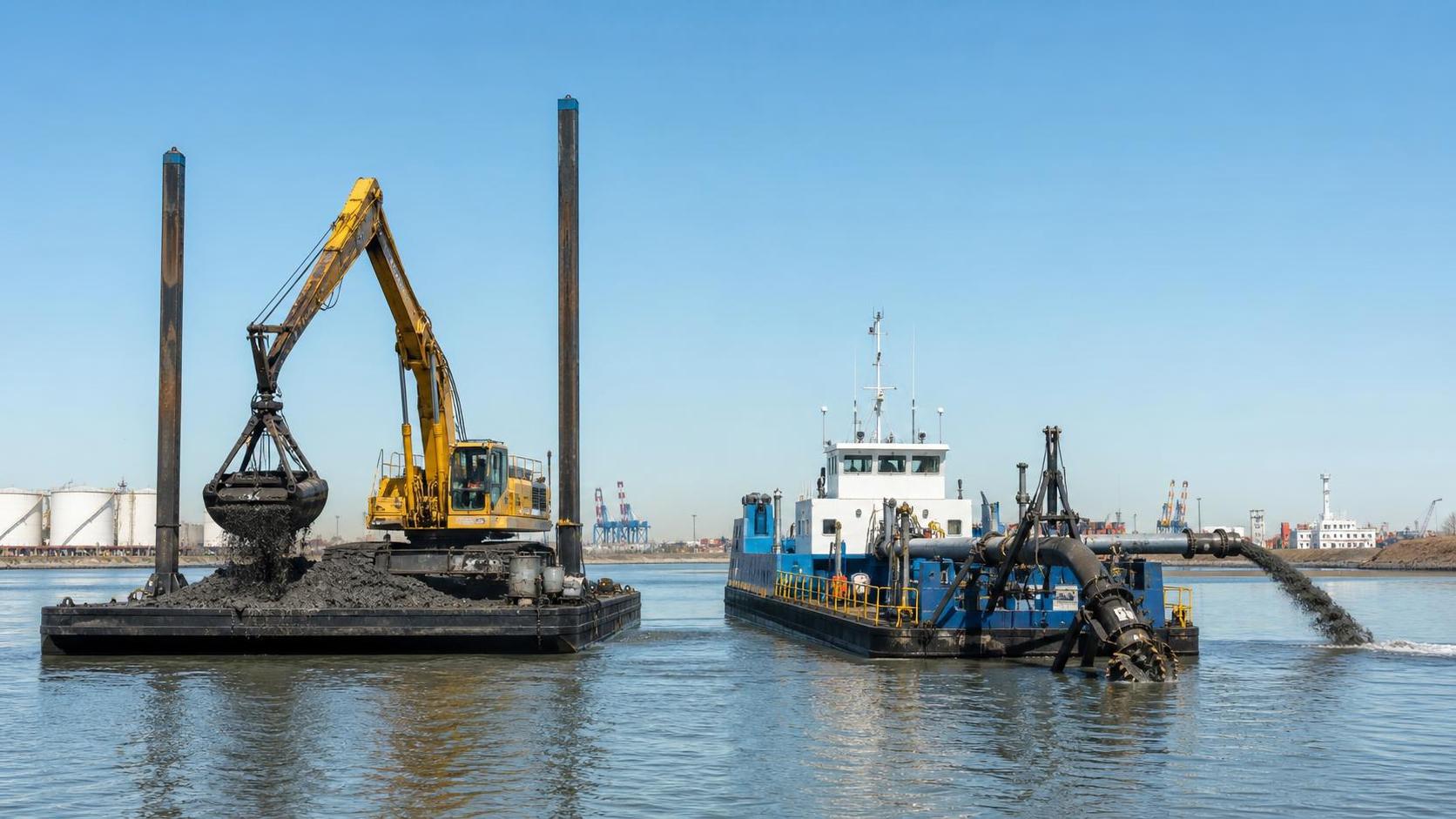
An excavator platform is typically a floating work platform, pontoon base, amphibious carrier, or spudded barge that supports a hydraulic excavator for underwater or shoreline excavation.
The excavator uses a boom, stick, bucket, grapple, rake, or specialized attachment to mechanically loosen and lift material from the waterbed, bank, or shallow submerged area.
Removed sediment is usually placed into a nearby barge, truck, stockpile area, geotextile container, or onshore disposal zone. The excavator does not normally transport slurry through a pipeline.
This arrangement gives operators strong control over the digging location. It is useful where sediment must be removed selectively around structures, slopes, bridge supports, docks, or shoreline features.
Excavator platforms can be configured with long-reach excavators, clamshell buckets, cutter attachments, tiltrotators, and hydraulic grapples depending on excavation depth and material characteristics.
Because the digging tool is mechanical, the system can handle oversized debris, branches, stones, concrete fragments, and mixed waste more effectively than many hydraulic dredging systems.
However, the excavation cycle is intermittent. The bucket digs, lifts, swings, unloads, and returns, which limits continuous material flow compared with a properly matched barge-mounted dredge.
How a Barge-Mounted Dredge Works
A barge-mounted dredge is a dredging system installed on a floating barge. It commonly uses a cutter suction head, suction pipe, dredge pump, ladder, spuds, and discharge pipeline.
During operation, the cutter head loosens soil while the pump draws water and sediment into the dredge line. The slurry is then transported through floating or shore-based pipelines.
This continuous pumping process makes barge-mounted dredges especially effective for moving large volumes of fine sediment, sand, mud, silt, and certain dredgeable clay formations.
Many systems use spuds or anchors to hold the barge in position. The dredge swings across a planned cut, gradually advancing through the work area in controlled passes.
Production depends on pump capacity, pipeline diameter, discharge distance, sediment concentration, cutter power, water conditions, and the resistance of the material being excavated.
A barge-mounted dredge is not automatically faster in every situation. Its performance can decline when debris is abundant, sediment contains large rocks, or access makes pipeline installation difficult.
Still, for long channels, ponds, reservoirs, sand recovery, port maintenance, and land reclamation projects, continuous hydraulic transport can provide a significant productivity advantage.
Key Difference One: Mechanical Digging Versus Hydraulic Dredging
The central difference is the excavation method. An excavator platform mechanically lifts sediment in discrete bucket loads, while a barge-mounted dredge hydraulically pumps a slurry through a pipeline.
Mechanical excavation is often more precise. Operators can target specific deposits, avoid sensitive structures, remove debris, and shape slopes with greater visual control over each digging movement.
Hydraulic dredging is generally more efficient when material must be transported over distance. Instead of handling each load individually, the dredge moves sediment continuously through a pipeline.
This distinction affects disposal planning. Excavator platforms need a receiving barge, truck route, shoreline stockpile, or nearby placement area. Dredges need a pipeline route and disposal basin.
When dewatering space is limited, both options require careful planning. Pumped slurry may need settling ponds, geotextile tubes, or mechanical dewatering before final disposal or beneficial reuse.
Projects involving contaminated sediment require additional controls regardless of equipment type. The preferred machine should minimize turbidity, prevent uncontrolled release, and support compliant material containment procedures.
Key Difference Two: Mobility and Site Access
Excavator platforms are often chosen because they can work in difficult-access locations. They can enter narrow ponds, shallow shorelines, marsh areas, construction sites, and irregular water bodies.
A floating excavator can reposition relatively quickly, especially when the project involves scattered deposits, short work zones, bank repairs, or several separate cleaning locations.
Some excavator-based solutions can work partly from land, reducing mobilization complexity. This can be valuable when water access is limited or the work area is close to a stable shoreline.
Barge-mounted dredges need adequate water access, launching space, and room for anchors, spuds, support boats, or pipeline deployment. These requirements can increase preparation time.
Once installed, however, a dredge can advance efficiently across a larger basin or channel. Its mobility is less flexible, but its planned operating pattern supports consistent production.
For remote projects, buyers should evaluate transport dimensions, lifting requirements, road permits, assembly time, and the availability of local cranes, service crews, fuel, and spare parts.
Key Difference Three: Digging Depth and Working Reach
An excavator platform’s working depth is limited primarily by boom and stick geometry. Long-reach excavators can extend farther, but deeper digging usually reduces breakout force and bucket capacity.
The machine must also maintain stability during lifting and swinging. Heavy material at maximum reach can create operational restrictions, particularly in waves, current, or unstable floating conditions.
A barge-mounted cutter suction dredge can reach greater depths when designed with an appropriate ladder length, pump configuration, and hull stability. Depth capability varies widely by model.
For deepening channels or restoring large reservoirs, dredges may offer a more practical working envelope. Their excavation depth is not governed by the same bucket lifting cycle.
Depth alone should not determine selection. Material density, target elevation accuracy, side slope requirements, water fluctuations, and the distance to disposal areas are equally important factors.
Before purchasing equipment, contractors should request verified operating depth ranges under realistic conditions rather than relying only on maximum theoretical specifications in sales literature.
Key Difference Four: Material Type and Debris Tolerance
Excavator platforms are highly versatile when material is variable. Buckets and attachments can remove clay, soil, stones, vegetation, trash, timber, scrap metal, and other obstructions.
This makes them valuable for rehabilitation projects where the bottom condition is uncertain. Operators can inspect, sort, and remove unexpected items without immediately stopping the entire operation.
Barge-mounted dredges are most productive when sediment is relatively uniform and pumpable. Fine sand, silt, mud, slurry, and loose deposits are usually suitable for hydraulic transport.
Large stones, heavy debris, dense roots, cables, and fabricated waste can block the suction system, damage the cutter head, or reduce pumping efficiency. Pre-clearing may be necessary.
Hard clay and compacted material may require stronger cutter power, specialized cutter heads, or mechanical pre-treatment. Equipment selection should be based on sediment investigation, not visual assumptions.
A practical project assessment includes sediment sampling, particle-size distribution, density testing, debris surveys, contamination review, and an estimate of expected solids concentration during dredging.
Key Difference Five: Production Rate and Project Duration
A barge-mounted dredge typically offers higher production potential for large, repetitive sediment removal work. Continuous pumping can move significant material volumes when the system is correctly matched.
Its actual output should be measured in delivered solids, not only slurry flow. High water content may create impressive pump figures while producing lower real sediment removal rates.
Excavator platform output is normally lower for bulk fine sediment, because each bucket cycle includes digging, lifting, swinging, unloading, and repositioning. Nevertheless, it can remain commercially competitive.
It becomes particularly competitive where hydraulic dredging would require excessive pipeline installation, difficult dewatering, long discharge routes, or costly treatment of large quantities of water.
For short-duration projects, setup time matters as much as hourly production. A smaller excavator platform may complete a localized job sooner because it mobilizes and begins working faster.
For multi-month maintenance dredging, a dedicated barge-mounted dredge may produce a lower cost per cubic meter through reduced material handling and more consistent operating cycles.
Key Difference Six: Stability, Safety, and Environmental Control
Both equipment types require engineered stability and disciplined operating procedures. Floating work introduces risks from uneven loading, current, wind, waves, changing water levels, and operator error.
Excavator platforms must account for boom movement, bucket load, swing direction, counterweight position, and deck capacity. The platform must be rated for the selected excavator and attachment.
Barge-mounted dredges require stable anchoring or spudding, pipeline management, safe access around rotating equipment, and controlled operation of pumps, winches, ladders, and cutter heads.
Environmental performance depends heavily on operating technique. Fast, uncontrolled excavation can increase turbidity, while excessive cutter action may disturb sediment beyond the intended excavation boundary.
Mechanical excavation can offer better selectivity near sensitive assets. Hydraulic dredging can reduce rehandling, but slurry containment and discharge management must be carefully designed and monitored.
Projects near intakes, habitats, navigation routes, or residential areas should include turbidity limits, spill response measures, exclusion zones, noise controls, and documented inspection routines.
How to Choose the Right Equipment for Your Project
Choose an excavator platform when the project requires selective digging, debris removal, shoreline access, frequent relocation, mixed materials, or precise work near structures and obstacles.
It is also a strong choice when the disposal area is close enough for barges, trucks, or stockpiling, and when installing a long slurry pipeline would add unnecessary cost.
Choose a barge-mounted dredge when the project involves large sediment volumes, relatively pumpable material, planned excavation patterns, available pipeline routes, and a suitable discharge or containment area.
It is generally more attractive for channel deepening, port maintenance, reservoir restoration, sand mining, reclamation, and other applications where continuous production drives overall project economics.
Do not select only by purchase price. Compare mobilization, fuel consumption, crew size, spare parts, maintenance intervals, discharge infrastructure, dewatering needs, transportation, and expected production performance.
Request a supplier’s technical proposal with material assumptions clearly stated. A credible proposal should identify pump specifications, excavation depth, expected capacity range, pipeline limits, power requirements, and operating conditions.
What to Ask a Dredging Equipment Manufacturer
Ask whether the manufacturer has experience with your sediment type, water depth, discharge distance, and local operating conditions. Generic capacity claims are less useful than project-specific recommendations.
Confirm the steel grade, welding procedures, structural design standards, hydraulic components, electrical systems, and corrosion protection used in the platform, hull, dredge ladder, and pipeline sections.
For a barge-mounted dredge, review the pump curve, cutter power, pipeline diameter, maximum discharge distance, solids handling capability, and the availability of wear-resistant pump components.
For an excavator platform, confirm deck load rating, stability calculations, spud or anchoring arrangement, access layout, excavator compatibility, attachment options, and lifting or transport requirements.
Manufacturing quality matters because dredging machinery operates under abrasive, corrosive, and high-load conditions. Poor fabrication can create costly downtime, leakage, misalignment, cracking, and premature wear.
Reliable manufacturers use controlled steel cutting, high-precision welding, standardized assembly procedures, inspection processes, and water testing to verify equipment performance before delivery.
Final Takeaway
The difference between an excavator platform and a barge-mounted dredge is ultimately a difference in operating strategy. One emphasizes flexible mechanical excavation, while the other emphasizes continuous hydraulic transport.
An excavator platform is usually the better answer for selective, shallow, mixed-material, debris-heavy, or difficult-access work. It offers versatility and direct control over each excavation action.
A barge-mounted dredge is often the stronger choice for high-volume, pumpable sediment and established disposal routes. Its continuous workflow can improve productivity on larger, longer-duration projects.
The best decision comes from matching equipment to sediment conditions, depth, access, disposal method, environmental requirements, expected production, and the total cost of completing the work.
Before committing to a machine, evaluate the entire dredging system rather than one piece of equipment. The right hull, pump, excavator, pipeline, support equipment, and manufacturing quality determine project success.
Navigation
- How Can Noise Be Reduced During Port and Harbor Dredging Operations?
- What Is the Difference Between an Excavator Platform and a Barge-Mounted Dredge?
- Does Industrial Sand Dredging Require Water Discharge Permits?
- What Safety Features Should a Dredging Vessel Have?
- How to Calculate Dredging Volume for a River Project Bid
- Is Cutter Suction Dredging Better Than Bucket-Chain Dredging for Hardpan?
Send Us A Message